
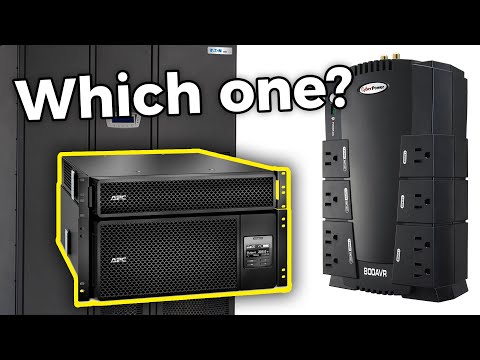
Radio engineer Joe Geerling explains UPSes, why you need one, and how to choose one, based on decades of experience building and maintaining critical radio infrastructure.
Support me on Patreon:
Sponsor me on GitHub:
Merch:
Main Channel:
#UPS #Backup #IT
Contents:
00:00 – Introduction
00:37 – Single workstation UPS
01:27 – Rackmount UPS
03:00 – Sizing a UPS
03:23 – Network integration and monitoring
04:21 – Getting clean power
04:54 – Battery hot-swap
06:36 – Battery chemistry and choice
08:55 – Stories from the trenches
09:47 – Why you need a UPS



Why tf are 95% of ups manufacturers still using lead acid batteries in 2025?
We run a 280kw Eaton and a 180kw Eaton in our datacenter. Their job is to hold the load until the 500kw generator outside comes online.
What would you suggest for a PC that runs at a max 3300W. The outlet is a 240v 20a outlet.
Important to remember that certain equipment, particularly those with motors, the power draw on startup is always higher than normal operations. You always want to account for that when determining what your needs for a ups are.
I came here to try to make sense of the specs given on UPS. I’m looking at a website that sells a huge range of UPS but the specifications make no sense to me and I’m fairly technically minded. Their performance is specified using two values with no explanation of what they’re talking about. The first figure is given as W (presumably Watts) and the second figure is given in VA (presumably Volt Amps). Since neither of these units include a time factor, it seems their capacity is not even being specified.
Even a tiny 1.5v Duracell could, theoretically deliver a KW of power for a microsecond. Also why the two values? For example the first UPS I’m looking at has a specification of “400W/800VA” I’m at a loss.